July 24, 2008

Podcast - Harrison Owen on Open Space

Over at my podcast blog Winkipod, I have just posted an inspiring podcast.

Viv just recorded Harrison Owen’s book launch speech at the 2008 OSOS Conference happening now in San Francisco, USA.

The quality of the sound is poor, however, Harrison’s words are inspiring!

Harrison Owen

Download Harrison Owen’s Book Launch Speech here

Listening Tip - if you have control over the Equaliser Levels, reduce the BASS frequencies to a minimum.

Cheers

Geoff
 

admin | Facilitation, Leadership | Comments (0)

July 24, 2008

Facilitating and Contribution

I had the pleasure of working with a large group of nearly 100 people today. I really enjoy the energy that a group this large can create.

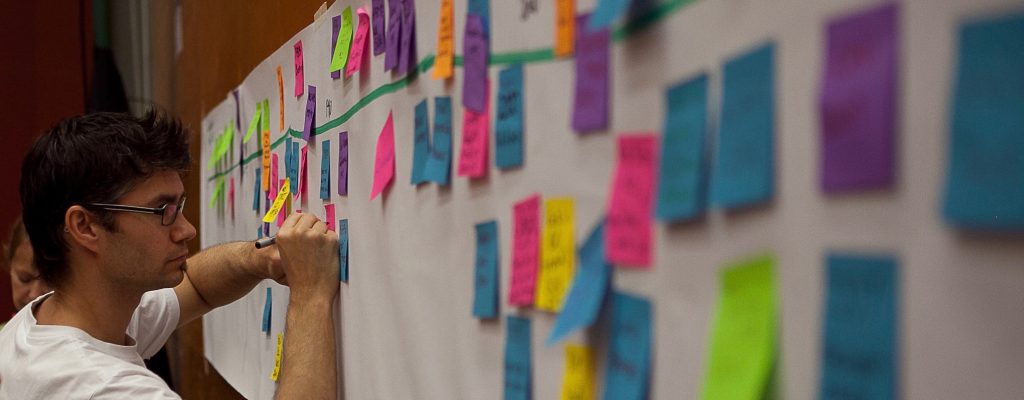
This image represents my facilitation role today. In between a score of guest speakers, I allowed the participants a voice … more than the usual Q&A’s … they had a chance to contribute their own thinking. For this, they thanked me.

Once you accept that the ‘wisdom of the crowd’ (at any conference) is greater than the ‘handful of keynote experts’, facilitating whole-group contribution is simply a matter of common sense. Aka ‘Unconferencing‘.

Geoff 

admin | Facilitation, Just observations | Comments (0)

July 20, 2008

WinkiPodcast explores Facilitation with Anne Pattillo

Viv and I had a face-face conversation last week with Anne Pattillo. This chat about ‘Facilitation’ was recorded and published here at our WinkiPodcast Blog

Anne points to the core of Facilitation and this image sums it up. Enjoy listening.


Geoff

admin | Facilitation, Podcasts that Rock! | Comments (0)

July 15, 2008

Story of Bubbles and Stuff

Have you seen Annie Leonard’s Story of Stuff video? You should watch it. I use parts of it when facilitating sustainability workshops to great effect. I have embedded it below.

Thanks to Dave Pollard’s weekly wrap, I discovered this article by Peter Senge and others. It is a prescription for Business Sustainability: Senge says business has to do much more than just mitigate and adapt to climate change.

I really liked the anology Senge drew between the short term bubbles we have seen (eg. dot com and sub prime) and the Industrial “bubble” that has been expanding for the past 2 centuries. I hadn’t thought about our unsustainable consumption in terms of a bubble which, like all bubbles, will eventually pop. In the case of .dot-com … the companies failed to make profits and it exploded. In the case of sub-prime … borrowers had to default loans and hedge funds lost billions and it exploded.

In this picture, I have sketched the industrial bubble. The pins around it’s perimeter are the forces acting back on it by nature. Nature is pushing back ’sharply’ at the bubble because of the stuff we extract and then put back as toxic waste and pollution. Communities and ‘coalitions of the willing’ who are devising solutions are pushing back too. Another sharp end that may pop the bubble is the “finite-ness” of the resources upon which the Industrial age depends … oil, clean water etc …

I wonder if the world community is capable of deflating the Industrial-Age Bubble (adaptation)? Or will forces from nature cause it to collapse quickly (survival and chaos)?

Within the bubble I have depicted The Story of Stuff process that Annie Leonard so beautifully describes. 

Senge also points out that a ‘real world’ belief system exists within the Industrial Bubble, just as it did with dot-com and sub-prime. Here’s a quote:

“When financial bubbles pop, the same question is always asked: How is it that over expansion and collapse occurred yet again, drawing in otherwise bright and knowledgeable people?

The answer is that during a period of overexpansion, two parallel views develop, one from inside the bubble and one from outside. Each perspective feels real to those who hold it. The more the bubble grows, the more people are drawn into the powerful reinforcing beliefs and perceptions it inspires. Eventually, those inside the bubble become so absorbed by its new reality that they can no longer understand the point of view of those outside the bubble.”

Taster from the Story of Stuff - Annie Leonard


Geoff

admin | Creative Stuff, Sustainability | Comments (1)

July 11, 2008

Spreading Solutions with video and art

In a recent post I explored applications for the visual art of Chris Jordon in enabling change.

Today (hat tip to Brendan McKeague) I discovered the Paul Lussier Company. Their mission is similar to Chris’ and my own in seeking solutions to the climate change challenge.

One of his projects is the creation of an online film called Blessed Unrest. Watch this!

BLESSED UNREST: THE FILM is created entirely on the film’s website. The site enables users to partake in collaborative editing in micro-communities devoted to certain themes set up by our directorial and editorial team. With the full resolution source tagging married to this collaborative editing interface, for the first time in history a film can jump from home page to the global stage with the click of a button.

One of my favourite authors is Paul Hawkin. His book The Ecology of Commerce is legendary and has influenced many world business leaders to change the direction of their companies. Here is Paul on his latest book, Blessed Unrest and Why No-one Saw it Coming.

Geoff


admin | Creative Stuff, How Stuff Spreads & Changes, Sustainability | Comments (1)

July 11, 2008

Collaborative Mindmapping

I have long been a fan of using mindmaps to think and capture ideas. As a facilitator I use mindmaps to create a visual map of decisions and ‘outputs’ from workshops.

Now I can use mindmaps to ‘collaborate’ with others by using a Web 2.0 application called Mind42. All you need is a Mind42 account and you can view and edit maps that I publish … a visual wiki!

Here is a real example that I used to communicate the outcomes of the Castlemaine 500 project earlier this year.


Cheers

Geoff 


admin | Vizual Thinking | Comments (1)

July 9, 2008

A Community Home Energy Assessment Model


Here’s some Home Energy Assessment videos that I put together for a group 4 community members. These 4 wonderful people took part in a Home Energy Assessment Training program as a part of the Castlemaine 500 project. You can read all about the ‘who/what/when/where/why/how’ of Castlemaine 500 here.

Our aim was to train local people in a process that assists householders to develop a ‘plan of action’. This plan contains energy saving actions such as shorter showers, topping up insulation and switching off electrical appliances at the wall when not in use.

To give the video some context, here are some words (and downloads) you will encounter in the videos:

  1. HEAT - The Home Energy Assessment Tool is used by households to self-assess their own energy consumption behaviours across all areas of household energy use. It is used as a key guide during the Home Energy Assessment process.
  2. HEAP - The Home Energy Action Plan is used to capture the energy-smart actions that households identify during the Home Energy Assessment process. These actions are given a target date for completion. 
  3. CVGA - Central Victorian Greenhouse Alliance own the C500 project and the Third Ecology project team ran the C500 project in partnership with the CVGA. My role is part of the Third Ecology Team.
  4. MASG - The Mount Alexander Sustainability Group partnered C500 in the training of Home Energy Assessors. Their guidance, support and local knowledge helped to make it happen!

The following videos were developed by me as a ‘refresher’ for the Community Home Energy Assessors. They were about to embark on 20 home energy assessments that they would do on their own, independently of the so called expert assessors in out project team.

From the householder feedback, it is clear that the process works and most would be willing to pay money for such a service!

Videos 1 to 4 - Meant to be viewed in order and they paint a picture of what the C500 Home Energy Assessment process looks like (from the perspective of the Home Energy Assessor).

1. Background and Context (6.17 mins)


2. Overview of the Home Energy Assessment Process (7.29 mins)


3. Nuts & Bolts #1 (8.19 mins)


4. Nuts & Bolts #2 (6.18 mins)


Hope these videos have been useful. Please contact the Central Victorian Greenhouse Alliance if you want more information or if you want to use any of the tools developed in C500 for your own community projects.

A big hat-tip to Lee and Sachi at Commoncraft for providing the inspiration to use their ‘paper-works’ technique to provide this refresher training in the Home Energy Assessment Process.

Cheers

Geoff 

admin | Sustainability, Vizual Thinking | Comments (0)

July 8, 2008

The unexpected in the home office

Following on from my podcast chat about the ‘Unexpected’ with Matt Moore and Viv McWaters, this happened to me just now.

I had a conference call with a client (planning out a workshop) and had my 9 month old baby in a backpack for all of it. Working from home is both a luxury and a challenge!

It was unavoidable, unplanned and rarely happens. Be prepared for anything!

Webcam photo taken during a real conference call

By the way, my client was fine with the babbling noises in the background and applauded me for ‘taking the risk’ to go ahead with the call.

Cheers

Geoff

admin | Just observations, Uncategorized | Comments (0)

July 7, 2008

Podcasting the Unexpected

Matt Moore had a chat with Viv and I over Skype last week. We chose to explore the theme of ‘The Unexpected’. Here is the result …

Matt Moore, Viv McWaters & Me explore the unexpected!

I really liked Matt’s metaphor ‘Beyond the Event Horizon‘ to highlight what happens (or fails to happen) after the event, workshop or whatever. The transition from workshop back to the real world is a dimension to my facilitation that I pay far more attention to now.

Thanks to Matt for these Show Notes:
00:00 - Introduction - Sick kids, adrenalin junkies & improvisation.
05:00 - Geoff’s camping holidays: Being Prepared vs. Having A Plan.
09:30 - Matt bounces up and down on the unscripted trampoline.
11:30 - Facilitation begins long before the event.
16:30 - Facilitation as transformation.
18:20 - What happens “beyond the event horizon”? What are the transitions?
20:00 - “Random Acts of Traction” - Before, During & After.
25:50 - The offer of support.
29:00 - Facilitators as Collective Memory.


We would be interested in any comments from listeners out there.

Warm Regards

Geoff


admin | Facilitation, Podcasts that Rock! | Comments (0)

July 7, 2008

HOPE

Gen Roberts at the Lorne Community House used this ‘HOPE’ acronym at the bottom of one her emails recently. I liked it and found myself playing around with my tablet … also learned a bit more about Corel Painter functions in the process :-)

Geoff

admin | Uncategorized | Comments (0)


Feed